

Our Research Affordable, accurate, detailed climate projections for climate-resilient agriculture in India
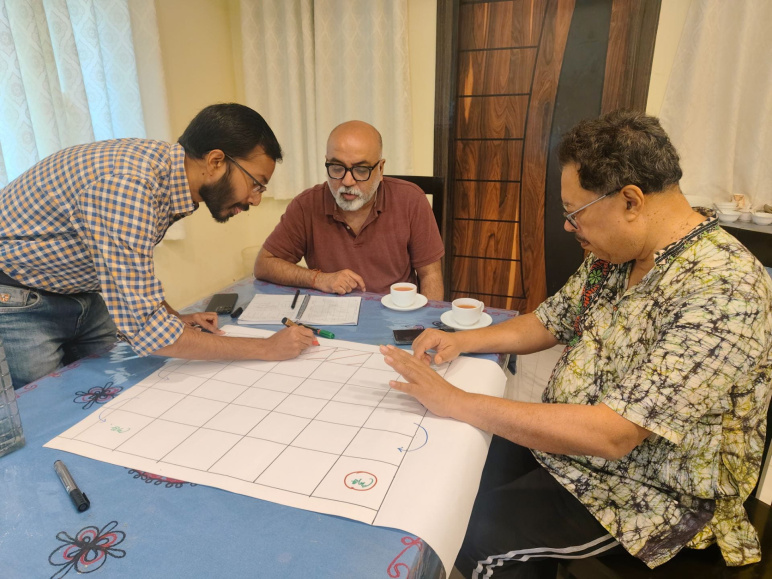
The research team: Anamitra Saha, Sai Ravela, and Jayanta Basu.
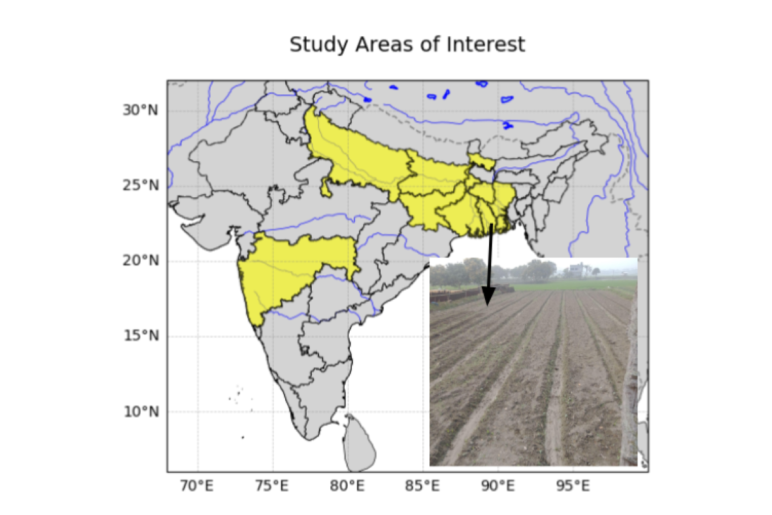
The regions of India highlighted in yellow will be the focus of this study.
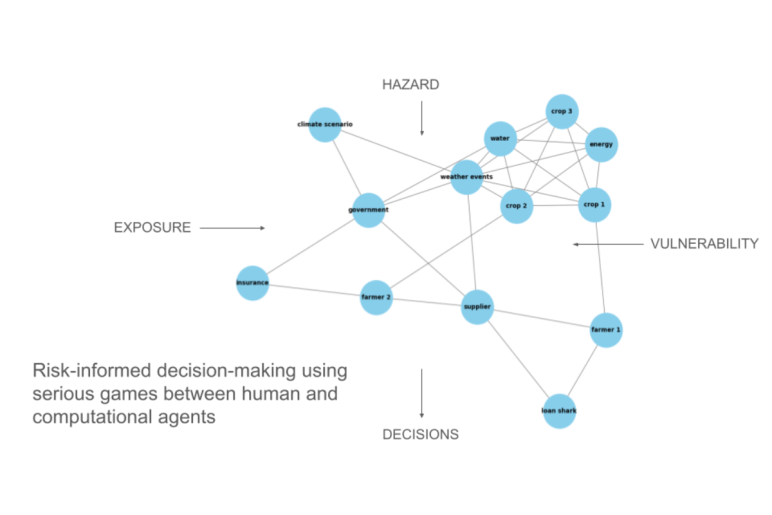
The research team will utilize this risk-informed decision making framework to evaluate how climate projections can improve sustainable agricultural decision-making.
The research team: Anamitra Saha, Sai Ravela, and Jayanta Basu.
The regions of India highlighted in yellow will be the focus of this study.
The research team will utilize this risk-informed decision making framework to evaluate how climate projections can improve sustainable agricultural decision-making.
Principal Investigators


Challenge:
How can climate projections quantify detailed agricultural risk? How does detailed risk assessment enable local sustainable agricultural practices?
Research Strategy
- Develop a computational approach to produce detailed local climate information and risk from available coarse climate model simulations
- Develop local agricultural decision support system for optimizing climate resilience, water and energy usage, and crop yield using an AI-based optimization framework
Project description
India’s economic productivity relies heavily on agriculture, which is threatened by climate change and the water crisis. To meet the growing demands, the country has implemented several agricultural policies with short-term benefits at the cost of long-term environmental sustainability. Rising temperatures, erratic monsoons, and increasing droughts are now putting the water and food security of the country, as well as farmer livelihoods, at risk. Could incorporating long-range (such as decadal) climate projections improve sustainable agricultural decision-making? To answer this hypothesis, the research team will aim to develop a climate-aware decision support system that agricultural policy planners can use for decision-making in water management, irrigation planning, supply chain stabilization, and crop variety selection. The proposal has two major components: a computational method that transforms coarse resolution climate simulations into detailed predictions for local decision-making, and an AI-based optimization framework that handles multiple competing objectives, such as increasing resilience against climate-related risks, minimizing water and energy usage, and maximizing crop yield, to enable sound practices and policies.
Outcomes
- Built a computational method that transforms coarse resolution climate simulations into detailed predictions for local decision-making, allowing for the ability to assess risks and co-design intervention strategies with communities in a way that is both computationally rigorous and socially grounded
- Deployed participatory methods to support community-driven decision-making under climate risk by engaging in a range of in-person interactions with local stakeholders, community members, and regional organizations to better understand local decision-making processes, livelihood constraints, and perceptions of risk
- Developed a computational model for optimizing interventions in the coupled waterlogging–salinity–sedimentation–drought system of the Sundarbans region of mangrove forests

Additional Details
Impact Areas
- Climate & Sustainability
Research Themes
- Water Resources & Infrastructure
- Sustainability & Adaptation
- Transforming Food Systems
- Modeling & Data Analytics
Year Funded
- 2025
Grant Type
- India Grant
Status
- Completed