

Our Research Machine learning-guided ligand design of PolyMOC gels for PFAS removal
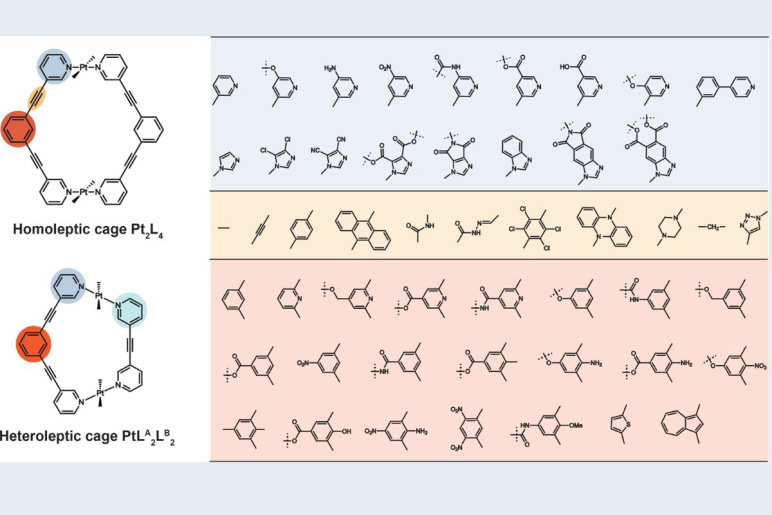
Pt cage (platinum-based molecular cage) library for PFAS removal. The ligand is divided into three parts, and the possible building blocks for each part are listed in the table at right. Dashed lines represent polyethylene glycol (PEG) connection sites. Image credit: Yuzhe Wang
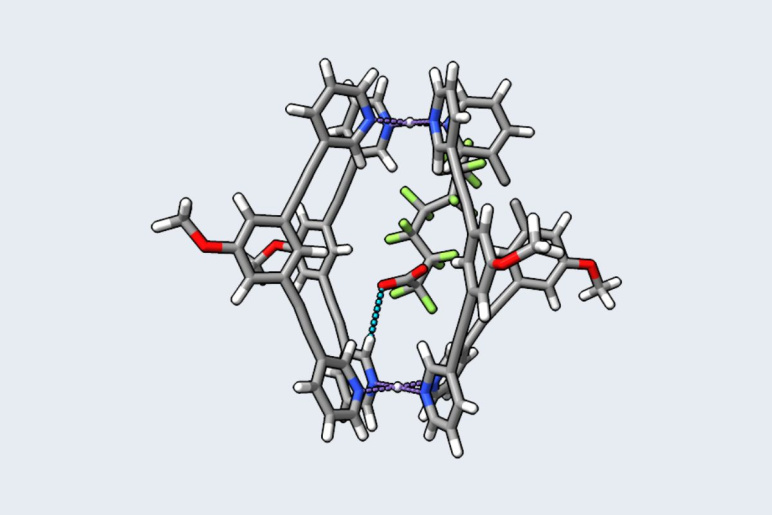
Snapshot from a dynamic simulation of a PFAS molecule binding inside a Pt cage. Image credit: Melissa Manetsch
Pt cage (platinum-based molecular cage) library for PFAS removal. The ligand is divided into three parts, and the possible building blocks for each part are listed in the table at right. Dashed lines represent polyethylene glycol (PEG) connection sites. Image credit: Yuzhe Wang
Snapshot from a dynamic simulation of a PFAS molecule binding inside a Pt cage. Image credit: Melissa Manetsch
Principal Investigators


Challenge:
How can we remove harmful PFAS (“forever chemicals”) from drinking water using sustainable materials that do not introduce new environmental contaminants? Can we rapidly discover and optimize these materials so they can be deployed more effectively in water treatment systems?
Research Strategy
- Design and test a new class of fluorine-free materials that can selectively capture PFAS from contaminated water
- Use artificial intelligence to identify which material designs are most likely to remove PFAS effectively while ignoring harmless substances naturally present in water
- Combine computational modeling with laboratory experiments to rapidly improve material performance and reduce trial-and-error testing
- Validate the most promising materials in realistic water samples to identify candidates for future water treatment applications
Project description
Per- and polyfluoroalkyl substances (PFAS), often called “forever chemicals,” are a growing threat to drinking water supplies worldwide. These chemicals are widely used in consumer products and industrial processes, but they persist in the environment and have been linked to adverse health effects, including cancer and immune system dysfunction. Current materials used to capture PFAS from water often contain fluorinated components themselves, creating sustainability concerns and the potential for additional environmental contamination.
This project aims to develop a new generation of fluorine-free materials that can selectively remove PFAS from contaminated water. The team will combine artificial intelligence, computer modeling, and laboratory experiments to identify the molecular features that enable strong PFAS capture. Using these insights, the researchers will rapidly screen thousands of candidate materials and prioritize the most promising designs for experimental testing.
By integrating predictive modeling with experimental validation, the project seeks to dramatically accelerate the discovery of effective water treatment materials while reducing reliance on costly trial-and-error approaches. The resulting design framework could help enable safer and more sustainable technologies for removing PFAS from drinking water and may also be adapted to address other emerging contaminants in the future.
Additional Details
Impact Areas
- Water
Research Themes
- Water Purification & Desalination
- Sensors & Monitoring
Year Funded
- 2026
Grant Type
- Seed Grant
Status
- Ongoing