
Our Research Continuous methane sensing in cattle to accelerate climate-smart feed development
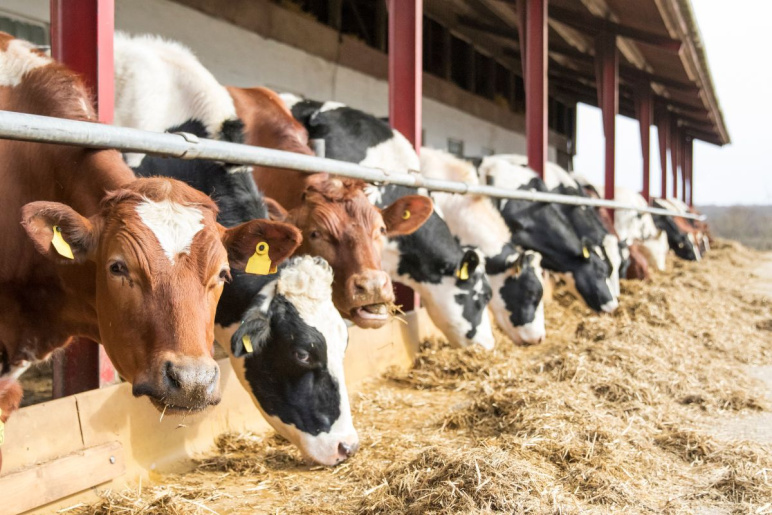
Methane from cattle is a major source of agricultural greenhouse gas emissions.
Principal Investigator

Giovanni Traverso
- Professor
- Department of Mechanical Engineering
Professor Giovanni Traverso is the Director of the Laboratory for Translational Engineering at MIT, a Professor of Mechanical Engineering at MIT, an Associate Physician in Gastroenterology at Brigham and Women’s Hospital, Harvard Medical School, and an Associate Member of the Broad Institute. He earned his undergraduate and medical degrees from the University of Cambridge and a PhD from Johns Hopkins University, where he pioneered non-invasive cancer detection methods. His postdoctoral research at MIT focused on advanced drug delivery and gastrointestinal sensing. His current work drives the development of next-generation drug delivery systems and ingestible devices for physiological monitoring.
Photo Credit: John Freidah
Challenge:
How can we continuously and affordably measure methane emissions inside cattle in real time, so we can identify feed additives that reliably reduce enteric methane under real farm conditions?
Research Strategy
- Build a small device that can stay in a cow’s rumen and measure methane continuously for about a week
- Test the device first in the lab, then in a few cattle, to make sure it works reliably and sends data wirelessly with minimal downtime
- Compare several feed additives before and after use to see which one most consistently lowers methane emissions without harming the animal’s nutrition
- Produce a dataset and analysis pipeline that can help identify climate-friendly feeds and support larger-scale testing later
Project description
This project will develop a small wireless device that can be placed inside a cow’s stomach compartment to measure methane continuously for several days. Methane from cattle is a major source of agricultural greenhouse gas emissions, but today there are few practical ways to track it over time in real farm settings. Our goal is to create a tool that can record methane inside the animal while it eats, rests, and transitions between feeds, then send those measurements wirelessly for analysis. We will first test the device in the lab to make sure it is accurate, durable, and safe in the harsh conditions of the digestive tract. Next, we will validate it in a small number of cattle and compare the readings with established methods. Finally, we will use the device to test different feed additives and diets to see which ones most consistently lower methane production without reducing animal health or nutrition. The expected outcome is a reliable, low-cost monitoring platform and a data set that can help farmers and researchers identify climate-friendly feeding strategies more quickly.
Additional Details
Impact Areas
- Food
- Climate & Sustainability
Research Themes
- Sustainability & Adaptation
- Soil Fertility & Crop Productivity
- Transforming Food Systems
Year Funded
- 2026
Grant Type
- Seed Grant
Status
- Ongoing