
News Trading for food security in a changing climate
Daniela Giardina, PhD, J-WAFS Executive Director October 6, 2026
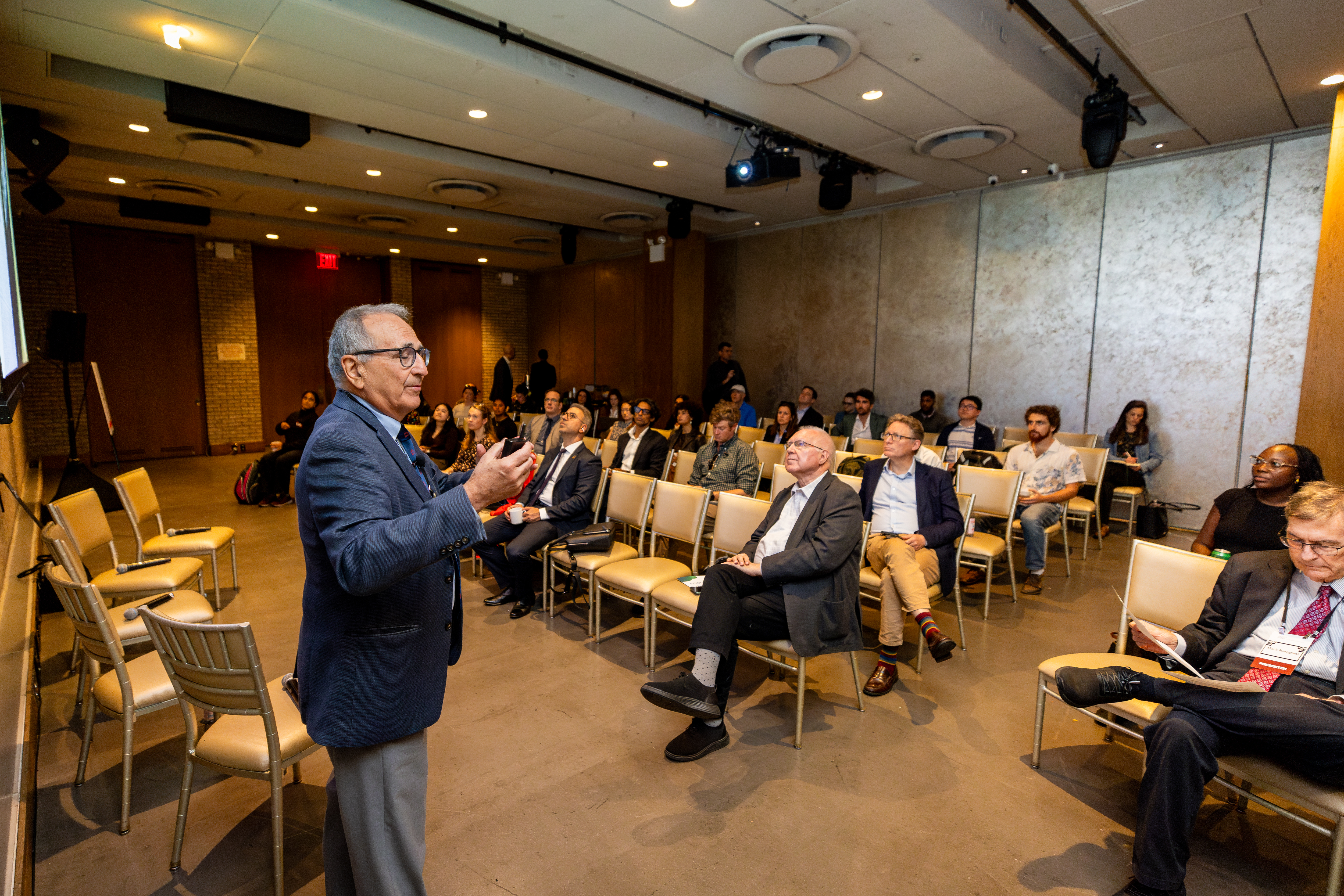
Kenneth Strzepek speaks to attendants at the New York Climate Week side-event.
No country can grow, or chooses to grow, everything its people need for a healthy diet. The variety that good nutrition requires depends, for the most part, on moving food across borders. Trade is necessary, but on its own it is not a resilience strategy. The gap between what the models say and what the market is willing to fund may be the biggest obstacle to building resilience before 2050.
On September 22, during Climate Week NYC, J-WAFS organized a panel on Trading for Food Security in a Changing Climate, with the support of the Climate Project at MIT. Ken Strzepek (J-WAFS) introduced the Jameel Index for Food Trade and Vulnerability, and Mark Rosegrant (IFPRI), Sheryl Hendriks (University of Pretoria), and Paola de Almeida (Natural Systems Capital, Inc) discussed the future of trade, with Greg Sixt (J-WAFS) moderating.
The panel's framing established the foundations of the tensions that exists within food trade. The Jameel Index shows that 84% of the world's population lives in countries classified as low vulnerability, yet nearly half of all nations remain exposed to import disruptions that climate shocks, conflicts and other changes will make worse. Often, "low vulnerability" simply means a country cannot afford to import much in the first place—it reflects limited purchasing power, not food security or good nutrition.
Mark Rosegrant stressed that the Index gives a richer picture of the relationships among food insecurity, trade, and economic and agricultural development than typical analyses. National food supply adequacy is more strongly associated with economic development than with trade vulnerability, which suggests that economic development is central to achieving healthy diets. Another way to frame it is that economic development and income growth both improve food security and increase food imports. Imports aren't bad per se.
Even under a pathway where global hunger declines, roughly 450 million people are projected to be at risk by 2050, concentrated in regions exposed to climate stress. The concern is how climate shocks could undermine progress and heighten instability in already vulnerable settings. The conversation that followed asked what it would take to change that trajectory.
The mismatch between scientific time and investment time
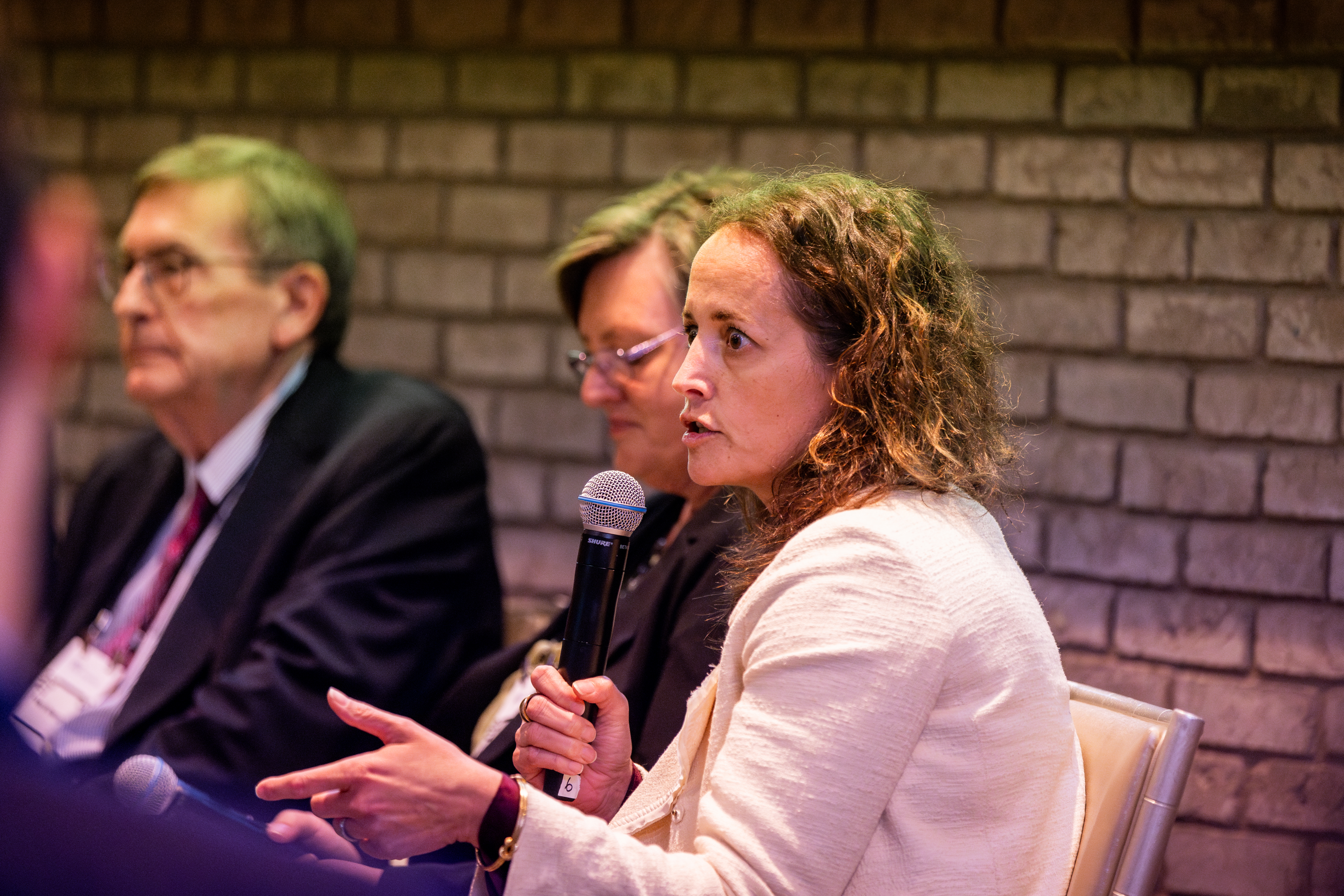
Paola de Almeida answers a question on the panel.
One of the sharpest tensions was about time horizons. For scientists, 2050 is not a distant milestone. It is the near-term output of models already running today, and the investments needed to bend that trajectory have to be deployed now. For investors, 2050 is a distant future, too far and too risky to justify capital at the scale the problem requires now.
That mismatch has consequences. The market will not deploy the volume of capital needed to build resilient and nourishing food systems while the risks remain unspecified. Proof of concept and proof of scale have to come before scale-up, and private capital is not willing to absorb that level of risk on its own, said Paola de Almeida. Ken Strzepek added that the physical infrastructure needed to withstand extreme weather events largely doesn't exist yet. This would let a wheat-growing region shift quickly to precision irrigation after a drought, for instance, rather than remaining exposed, and that has significant costs and structural implications for the change to occur. The panelists shared the view that trade is one resilience mechanism, but infrastructure is the one that must be financed, historically largely by the public sector, because the market won't get there in time on its own without the right portfolio of interventions clarified.
Long-term projections vs. short-term shocks
Part of the problem is that the available predictive and forecasting models can project long-term trends, but few capture short-term climate shocks, conflicts and the acute, compounding events that trigger a crisis. The scenario that Mark Rosegrant painted was a multiple breadbasket failure, in which several major wheat-producing regions fail at once, rather than the single-region disruptions most models are built around. Estimating the impact of salinization, flooding, and pest and disease pressure at that compounding, multi-region scale is the type of analysis the large macro global models aren't built to do.
Food security versus food sovereignty
Greg Sixt opened this thread with a question. The 2007 Declaration of Nyéléni defines food sovereignty as "the right of peoples to healthy and culturally appropriate food produced through ecologically sound and sustainable methods, and their right to define their own food and agriculture systems." Food sovereignty is often viewed as being at odds with the current global trade system, yet, as Strzepek’s presentation showed, trade is important for achieving healthy diets. How can trade support food sovereignty in a world with increasing shocks and threats to food security? Can it? Sheryl Hendriks said that in a world of increasing shocks, that tension often resurfaces as fear: the impulse to stockpile grain locally, even when trade would deliver food more efficiently, is a rational response to unpredictability, not a policy failure.
The same friction plays out at the household level, and in the mismatch between who sets the rules and who acts on them day by day. Governments negotiate trade policy as a regulatory exercise, but consumers make daily purchasing choices in the market, often pulling in different directions. Aligning incentives across governments, markets, and households so that everyone moves toward the same outcome rather than against each other, was framed as one of the harder unsolved problems in the room.
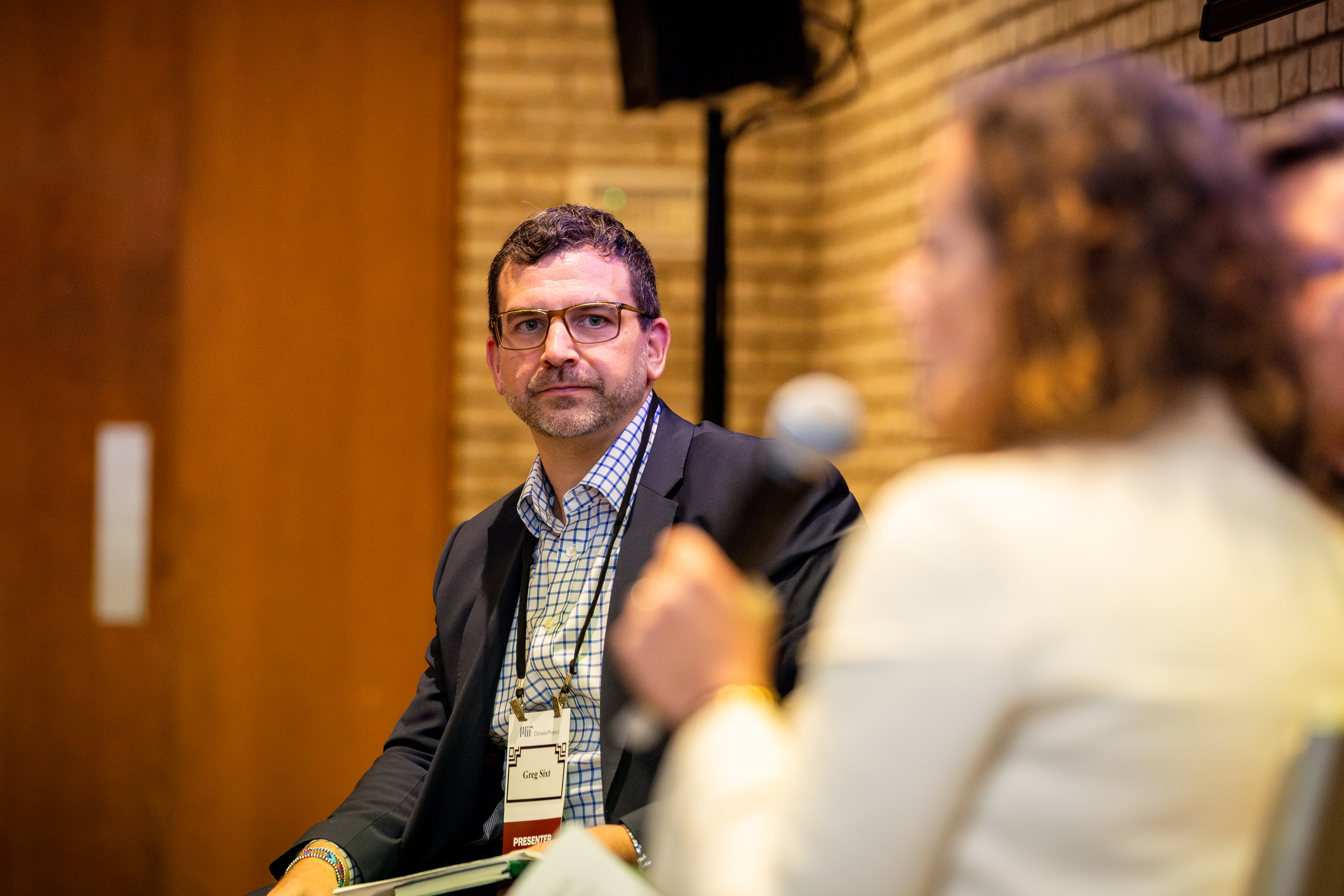
Greg Sixt was the moderator of the panel.
Financing resilience: not all money is created equal
On financing, the discussion pushed back on the idea that "more investment" is a sufficient answer. What's missing is clarity about the basic components worth investing in, and about what kind of returns are realistic for infrastructure with long payback horizons, closer to an annuity than a typical venture return, Paola de Almeida noted. There was a case for outcome-based approaches over prescriptive ones: focus on what a system needs to deliver rather than dictating a single practice, and let local actors, including community-level rules and bylaws, drive behavior at the scale where it is enforceable.
Sixt added a comparison with the energy sector: the agricultural sector makes the energy sector look comparatively simple. The scale of public subsidy that has gone into the energy transition dwarfs what agriculture has received, even though the food system faces comparable, arguably more urgent, transformation needs.
Beyond staple crops
Not every food system risk gets equal attention. Seafood was raised as a strikingly understudied sector. In many regions the world lacks a clear picture of fish stock levels, considering that different pressures and shocks continue to draw stocks down. Aquaculture and fish farming research were flagged as underinvested relative to the sector's role in nutrition and livelihoods.
Is the world ready?
The discussion circled back to one question: is the world ready for a systems-level transformation of agriculture? That would mean not a technology swap or a new financing vehicle, but a coordinated, transdisciplinary orchestration of trade policy, infrastructure investment, local governance, and household behavior all moving in the same direction. Given how diverse agroclimatic conditions are from one region to the next, no single lever transforms the whole system. The argument in the room was less "build a bigger system" and more "build a better one first," pragmatically, one workable piece at a time, before scaling.
The most useful takeaway came from Paola de Almeida, who argued for a tactical rather than an activist approach. A takeaway from this is a shift in where the effort goes. An activist approach starts with the scale of the problem and calls for the whole system to change. A tactical approach starts from what can be built and financed now: a specific problem statement resolved with an infrastructure solution, a workable set of local rules, a first proof of concept that unlocks a platform for investment and that shows the returns are market appropriate and risk can be managed. Once a platform is established, it can be replicated, and it gives investors and public funders something concrete to back many times over, just like alternative energy platforms – the model exists. That means influencing the decisions that shape each piece, rather than campaigning for a transformation that is more difficult to finance.
The UN Food and Agriculture Organization says that almost 25% of all agricultural goods are traded internationally. The infrastructure, financing and governance that would make the trade networks resilient rather than exposed are still being built, and the panel was clear that the private market will not build them in time on its own. The window to do this before 2050 is now, and it will require public intervention to make it happen.
Panel members Mark Rosegrant (IFPRI), Sheryl Hendriks (University of Pretoria), and Paola de Almeida (Natural Systems Capital, Inc).