

News Robbie Wilson interviewed by Dutch reporter Gemma Venhuizen
The J-WAFS researcher recently spoke about his work on photosynthesis for an article in the Dutch media outlet NRC.
January 16, 2026
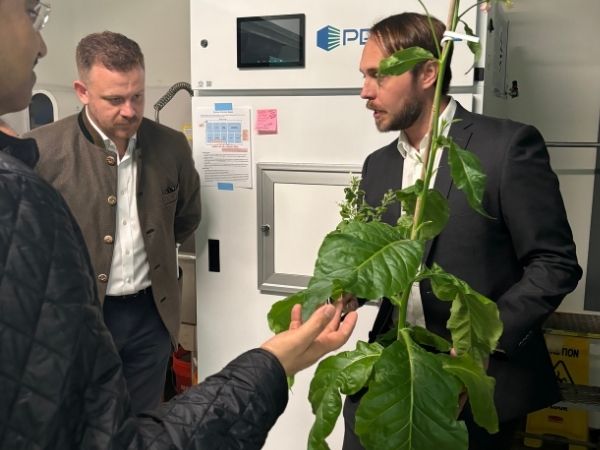
Robbie Wilson, PhD, showcases a plant experiment to others during a lab tour.
In December, Gemma Venhuizen, science journalist and editor at NRC, published an article about possible ways to streamline the process of photosynthesis in plants for faster crop production. A J-WAFS Grand Challenge project is, in fact, trying to tackle this very same issue. Led by Professor Matt Shoulders and Robbie Wilson, PhD, of the Department of Chemistry, the J-WAFS project is specifically looking to improve a photosynthetic enzyme called Ribulose-1,5-Bisphosphate Carboxylase/Oxygenase, otherwise known as RuBisCO.
The team is using the most advanced tools in molecular biology and computer science to identify, predict, install, and screen improvements to RuBisCO’s kinetic activity. To do this, they are using staged expression pipelines from bacteria to vascular plants to characterize RuBisCO variants and validate mutants.
Below, Venhuizen and Wilson explain more in excerpts translated to English from Venhuizen’s piece. The link to Venhuizen’s full article, published in December 2025, can be found here.
Excerpts
- Wilson: "Almost all the carbon in sugar, fat and proteins was once created thanks to rubisco."
- Venhuizen: “But rubisco is far from efficient in nature: it is excruciatingly slow (with 1 to 10 reactions per second, compared to 100 to 1,000 reactions in many other enzymes) and requires a lot of nitrogen to produce it. And then, in about one in three reactions performed by rubisco, oxygen is accidentally used instead of carbon dioxide. This error leads to a process, photorespiration, which actually releases CO2 – and so it only costs the plant energy. About 30 percent of the energy is lost as a result.”
- Wilson: "Remember: if millions of years of plant evolution couldn't already make rubisco more efficient, then this is probably the most difficult problem to solve in evolutionary biology… Because photosynthesis is so essential for life, you would expect nature to select for every possible advantageous rubisco mutation. You will most likely need a whole series of changes."
- Venhuizen: “Last summer, [Wilson] and colleagues published an article in the journal PNAS about the artificial evolution of a natural rubisco variant.
It normally occurs in Gallionellaceae, ancient bacteria that live in environments with a lot of carbon dioxide and little oxygen and are considered one of the fastest acting rubisco variants on earth, with more than 25 conversions per second.
What made the new technique of Wilson and colleagues special is that the mutations took place in vivo, i.e. in the bacterium itself instead of in the test tube.”
- Wilson: "As a result, you can generate a lot of extra mutations within a short period of time."
- Venhuizen: “[The researchers] discovered three promising mutations that increase rubisco's resistance to oxygen to such an extent that it would lead to less photorespiration – all in all, the efficiency of the enzyme could be increased by up to 25 percent.”
- Wilson: "And if you have more efficient rubisco, a plant loses less water, because normally hundreds of water molecules are lost for the absorption of each CO2 molecule. Also, with higher efficiency, less nitrogen is needed for the production of the enzyme."