
News J-WAFS welcomes postdoc Noormah Rizwan
September 2, 2026
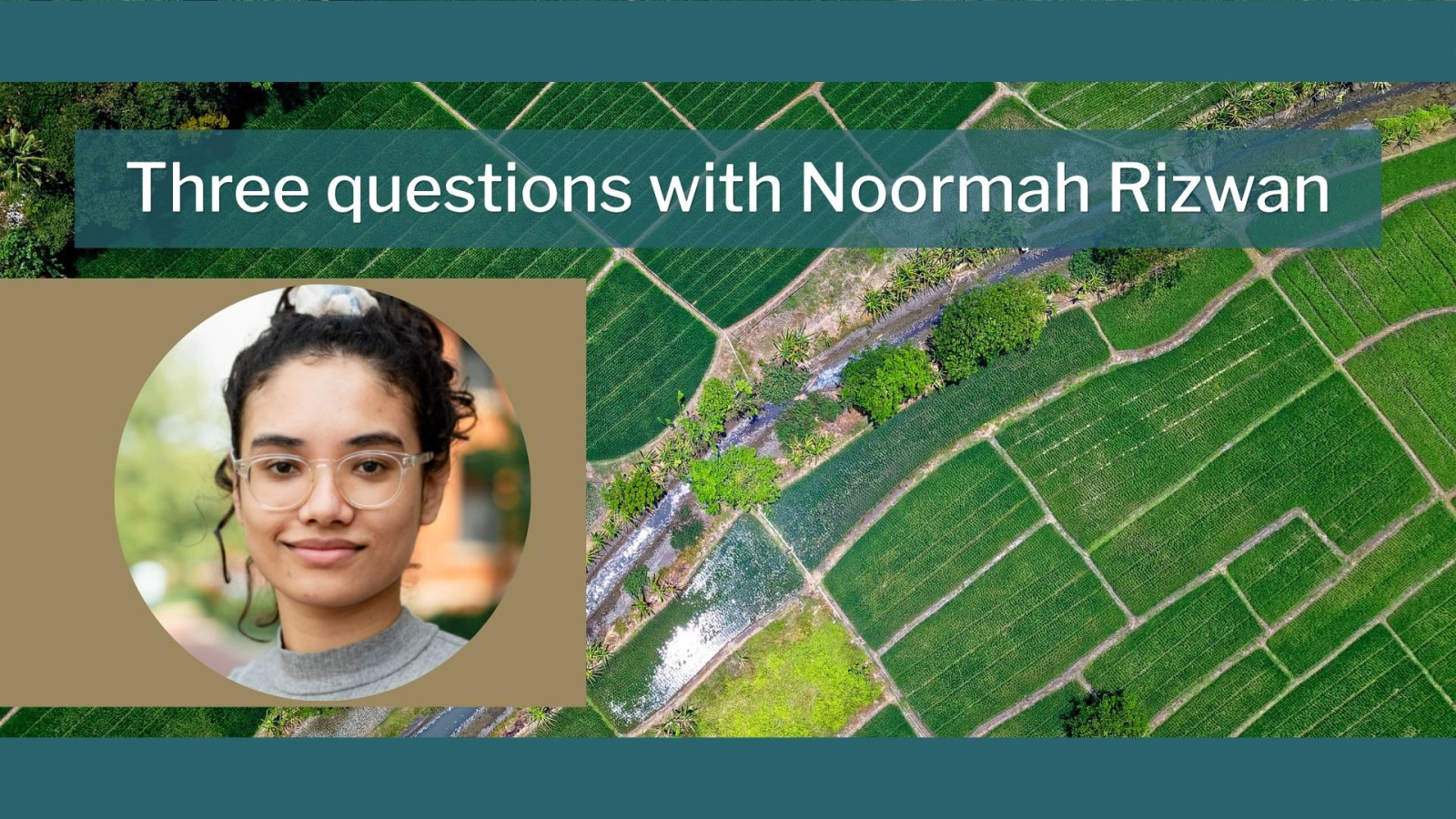
J-WAFS welcomes Noormah Rizwan, a postdoctoral associate who is working with J-WAFS to develop and apply an original analytical framework for assessing irrigation technologies in dry areas. The framework evaluates both technological maturity and the conditions required for successful deployment at scale, while identifying gaps where promising solutions are lacking or have yet to scale. Learn more about Noormah in these next three questions!
Where are you from and what’s your academic background?
I’m from Pakistan, where I was born and raised and spent most of my life. My interest in environmental and resource economics grew from my early research experience there, particularly while working at IFPRI on agricultural and water policy. One project on groundwater depletion and farmers’ water-use decisions in an arid region of Pakistan made me especially interested in how people respond to water scarcity when their choices are shaped by economic constraints, institutions, and limited alternatives.
That experience ultimately led me to pursue a PhD in agricultural, food, and resource economics at Michigan State University, where my research focused on adaptation to water scarcity and climate change. In particular, I studied how changes in management practices and technology adoption can help farmers mitigate climate-related losses, as well as how informal markets can alleviate some of the inequities created by unreliable piped-water infrastructure in urban water systems.
What led you to this postdoc?
What particularly drew me to this J-WAFS postdoc is that it builds naturally on the research I pursued during my PhD while allowing me to engage with highly policy-oriented questions. One of the main reasons I pursued a PhD was to develop the tools to work across disciplines and contribute to research that addresses real-world challenges.
My doctoral research examined how farmers adapt to water scarcity and climate change, including when and where they are likely to adopt irrigation. That work made me realize that predicting adoption is only part of the story. A technology can be technically effective and still fail to scale because of costs, infrastructure, institutions, maintenance, or other implementation barriers. This project allows me to take the next step and ask what actually enables technologies to be deployed successfully and sustainably at scale.
I was also drawn to the stakeholder-facing nature of the position. During my time at IFPRI, I saw how valuable it is to engage directly with policymakers and practitioners to understand the constraints they face and ensure that research is genuinely useful to them.
What are you most looking forward to at J-WAFS?
I’m most looking forward to working in an interdisciplinary environment where water challenges are approached not only through economics and policy, but also through engineering, technology, and innovation. Much of my research has focused on incentives, adoption, institutions, and distributional impacts, but many water challenges also require better technologies and a deeper understanding of how those technologies work in practice.
I’m excited about the opportunity to learn from engineers, water-systems researchers, economists, and practitioners, and to bring these perspectives together to evaluate solutions more comprehensively. I’m especially looking forward to contributing to research that can help translate technological innovation into practical strategies that are useful to policymakers and other decision-makers.