

News J-WAFS PIs present on a panel at MIT's inaugural Future Fest
Sophia Steckler, J-WAFS October 5, 2026
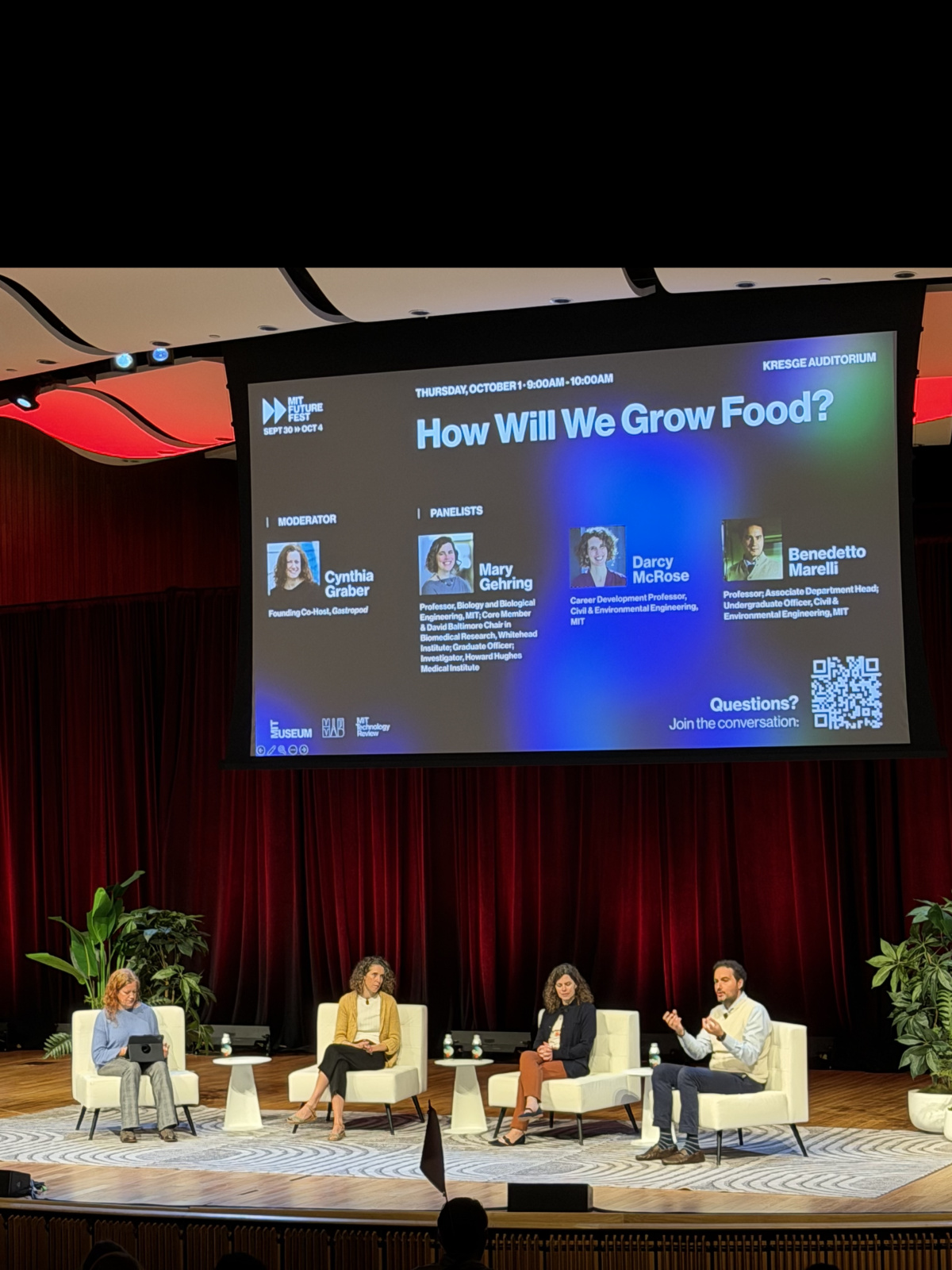
From left to right: Panel moderator Cynthia Graber, Darcy McRose, Mary Gehring, and Benedetto Marelli.
MIT recently held an inaugural five-day festival that featured more than 50 public talks, tours, performances, and exhibitions of work being conducted across the Institute. One of the panels at the event featured three J-WAFS PIs: Mary Gehring, Darcy McRose, and Benedetto Marelli. The researchers discussed how climate change is reshaping agriculture and how plant biology, microbiology, and materials science can help feed a growing population. They pointed to intensifying rainfall and drought, rising temperatures, and less fertile soils as pressures that will change which crops can be grown and which practices farmers will need to use. Some practices will be new, requiring farmers to learn them.
Gehring described her lab’s work on the basic biology of how plants make seeds, and her effort to genetically engineer seeds to produce greater crop yields. Hybrid corn is more vigorous than either parent, a trait that drove major productivity gains. Her lab is now working on soybean, aiming to have hybrid vigor pass from one generation to the next.
McRose focuses on the microbes that live in and around plants, which can be beneficial or harmful. Her work looks at how microbes help plants access nutrients such as phosphorus, and how the nutrient extraction works.
Marelli’s lab develops ways to deliver beneficial microbes to the soil by encapsulating them in a seed coating made through a water-based process that protects these helpful microbes.
The panelists were candid about the challenge of moving from lab to field. Agricultural markets are high-volume and low-margin, and new technologies can take multiple growing seasons to develop. Often, farmers are asked to simply trust a new practice. If technologies work, Gehring noted that even a 10% increase in crop yields would be huge while Marelli emphasized community-level impact—giving people who lack access to modern agricultural tools can lead to fewer inputs and less labor.