

News J-WAFS hosts seminar on alternative proteins and the global food system
Sophia Steckler, J-WAFS November 3, 2026
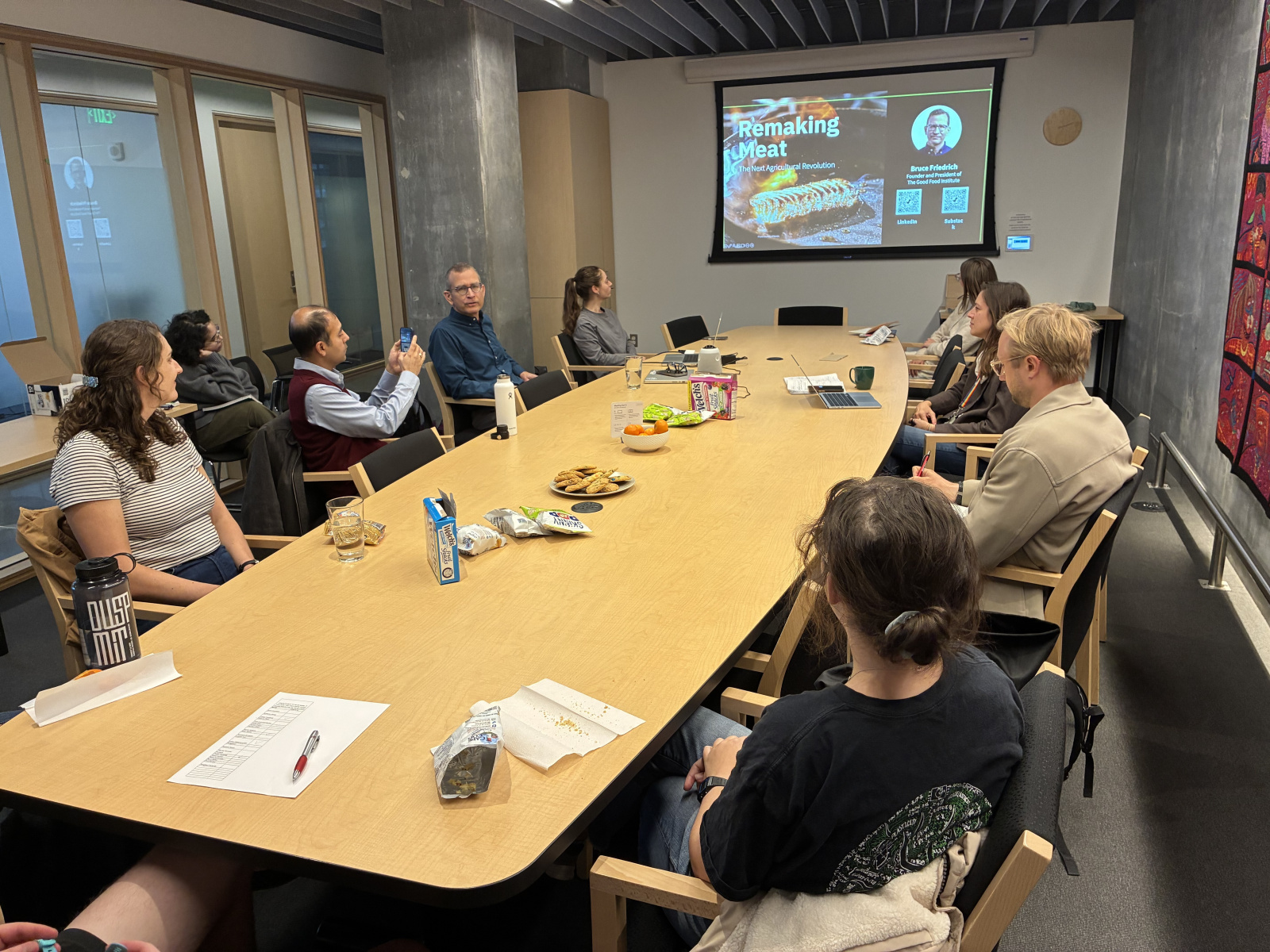
On October 26, J-WAFS hosted Bruce Friedrich, founder and president of the Good Food Institute (GFI), for a seminar on how alternative proteins can help address pressing challenges in the global food system. The talk was open to the MIT community and those from surrounding institutions and organizations.
Friedrich began by examining the external costs of conventional meat production, drawing on his book Meat. These include pandemic risk, antimicrobial resistance, climate change, air and water pollution, and hunger and malnutrition. He noted that meat has been produced largely the same way for 12,000 years, and that the process is resource-intensive, with only a small fraction of feed calories converted into meat. Fifty years of messaging from various interest groups urging people to eat less meat has not slowed production, which rises every year. Friedrich’s proposed answer is to change the supply, by making plant-based and cultivated meat that can compete with conventional products in terms of both cost and taste parity, rather than wait for demand to drop.
Friedrich went on to describe how the plant-based and cultivated meat field has changed since 2016, when there had been no government funding for alternative meat research in the previous decade — only two conferences on cultivated meat and ten cultivated meat patents ever issued. Today, ten alternative meat products have been approved across five counties, more than 1,500 cultivated meat patents have been issued, and many nations are investing in the field. He noted that cultivated meat media costs have dropped by more than 99% relative to the pharmaceutical baseline, and he cited Tufts University’s Professor David Kaplan on recent progress in cell isolation, cell immortalization, and media cost reduction.
Friedrich stressed that success is “not self-executing.” He called on governments to fund open-access research, offer incentives for private-sector R&D, and invest in shared-use facilities and pilot plants. He pointed to penicillin, the Human Genome Project, solar power, electric vehicles, and mRNA vaccines as examples of technologies that reached a tipping point with sustained investment.
He closed with ways for the MIT community to get involved, including GFI’s Alt Protein Project, which is active on 77 campuses, with an invitation to researchers working in the environment, food security, global development, and global health to help shape the field. An engaging audience Q&A followed the talk.
J-WAFS thanks Bruce Friedrich for visiting and sharing his work with the MIT community, and thanks everyone who attended.