
News J-WAFS at the 11th United Nations Science, Technology and Innovation Forum
Daniela Giardina Executive Director of J-WAFS June 17, 2026
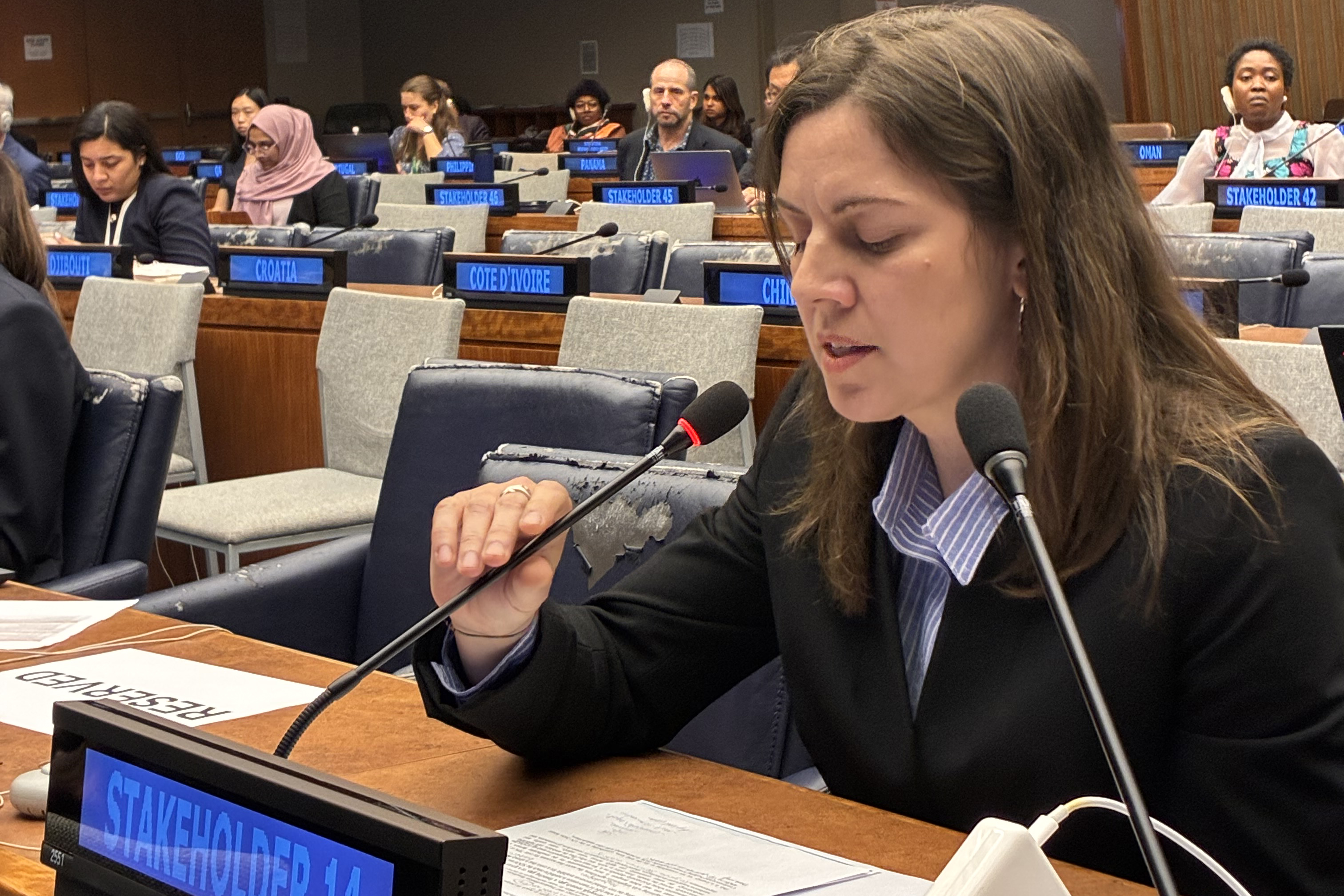
The 11th United Nations Science, Technology and Innovation Forum took place in New York on 6 and 7 May 2026 and I represented J-WAFS together with my colleague Greg Sixt.
In Session 1, "Transforming water systems with science, technology and innovation," I had the opportunity to read a statement on the research J-WAFS is now embarking on:
“What does it take for water technologies to reach the people who need them, at scale, in water-scarce regions?”
We want to understand what moves the needle from pilot to widespread use. J-WAFS is developing a Technology and Implementation Readiness framework to work out, case by case, whether the binding constraint is a research gap, a financing gap, a governance gap, a capacity gap or an adoption gap, because the answer decides what kind of intervention is needed.
Since the preparatory meeting for the UN Water conference in Dakar, this past January 2026, we have put the partnership together, we are recruiting a postdoc to lead the work, and we are looking toward our contribution to the 2026 UN Water Conference. We are beginning with water in agriculture, since the sector accounts for roughly 70% of the freshwater we use, but the aim is a method the wider water community can reuse across water supply, quality and sanitation, published openly for anyone to use.
Read the full statement here.
A failure of systems, not science
Beyond the session where we read the statement, discussions in other sessions focused on affordability and access. More than 900 solutions came through the Forum's open call this year, with strong participation from developing countries, and some of the examples that were cited were practical, rather than cutting-edge innovations, for example solar systems up to 80% lighter, water-monitoring tools up to 80% cheaper. Several speakers mentioned that AI could deepen the divide if it carries on being built for well- resourced contexts.
I always enjoy going to the side events at conferences, because it is often there that I learn the most, and the STI was no different.
My colleague Greg took part in the launch of ATIO, FAO's Agrifood Systems Technologies and Innovations Outlook. ATIO is an open-access knowledge base that catalogues innovations from across the spectrum, including grassroot innovation, and its biennial report sets out to close the STI gap in lower-income countries. I was impressed by how inclusive the catalogue is, and how easily one can find an innovation that could fit their needs.
The other event I followed most closely was "Transformative and Equitable Agricultural Technology for the 2030 Agenda and a Sustainable Future," also organized by FAO.
The FAO representative ran through so many advances in technologies for agriculture from genomics and AI-based pest prediction to satellites, sensors and digital platforms, from early warning systems that give critical lead time to robotics and automation, and yet people still go hungry, with much of that gap concentrated in Africa. They called it a failure of systems, not science. Interventions from some Members State representatives highlighted similar points, mentioning that often policy and enabling regulatory frameworks are an afterthought, when they should be precondition for innovation.
But the interventions that captured my attention were the ones discussing adoption and people's behaviors and beliefs.
The Behavioural Insights Team studied the gaps between a good technology and its uptake across more than 30 studies. They found that farmers discount payoffs that are slow to arrive (partly why regenerative practices are so hard to promote) and that they trust a tool that protects them from loss more readily than one that promises efficiency. Anything that ignores or undermines their existing competencies is not a solution. And the behavioral change needed to facilitate uptake goes together with the concept of "emotional readiness," which I picked up from Arizona State University, that is understanding the motivational barriers to adopting a technology that feels risky. Adoption and behaviors are gaps our framework will need to capture to be comprehensive along with other dimensions that the research will uncover.
The official summary of the water session recorded broad agreement that science and technology are indispensable for reaching SDG 6, but that technology alone will not be enough. We need governance, financing, strong institutions, and inclusive participation, to support the translation of technologies into practice.
All of this carries on to the UN Water Conference in Abu Dhabi this December 2026 and the close of the Water Action Decade in 2028.
This is a long road, and we are at the start: what does it take to get these technologies to the people who need them, at scale? If you are working in this space, I would like to hear from you.
Daniela Giardina, dgiard@mit.edu