

Our Research Sustainable hydrogel microparticles for the removal of micropollutants from water

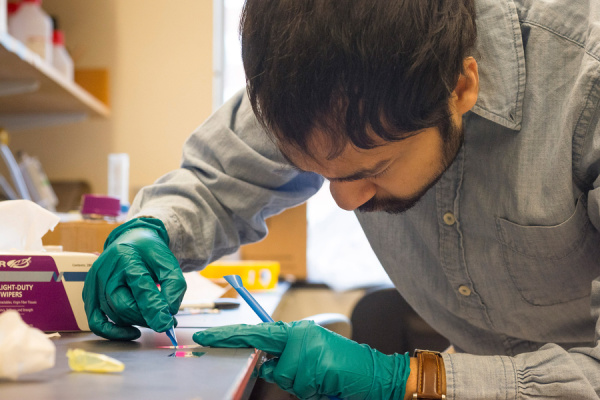
Graduate student Devashish Gokhale working on the hydrogel technology in the Doyle group lab at MIT. (Image credit: Sebastian Gonzalez Quintero)

Hydrogel microparticles saturated with iron after being used to clean highly contaminated water. (Image credit: Sebastian Gonzalez Quintero)

A bench-scale test filter used by the team in early experiments. (Image credit: Sebastian Gonzalez Quintero)
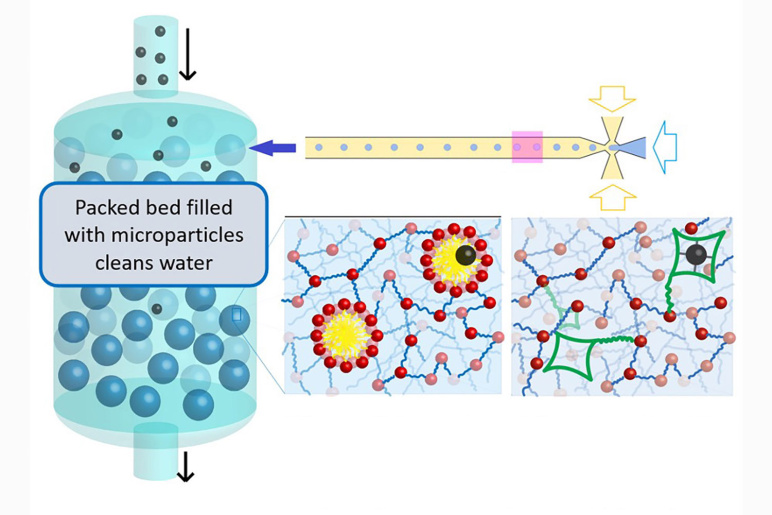
Overview of water treatment technology. Monomer solution is polymerized to make microparticles using scalable fluid processing. Microparticles can have different functionalities and each functionality can be tuned (change surfactants, chelating agents).
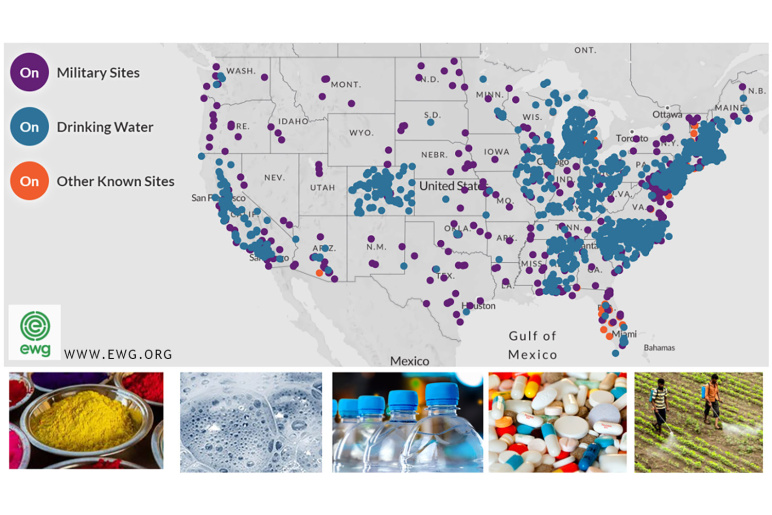
Sites at which PFAS, a specific kind of micropollutant were known to be persistently present, as of 2022 (figure taken from https://www.ewg.org).
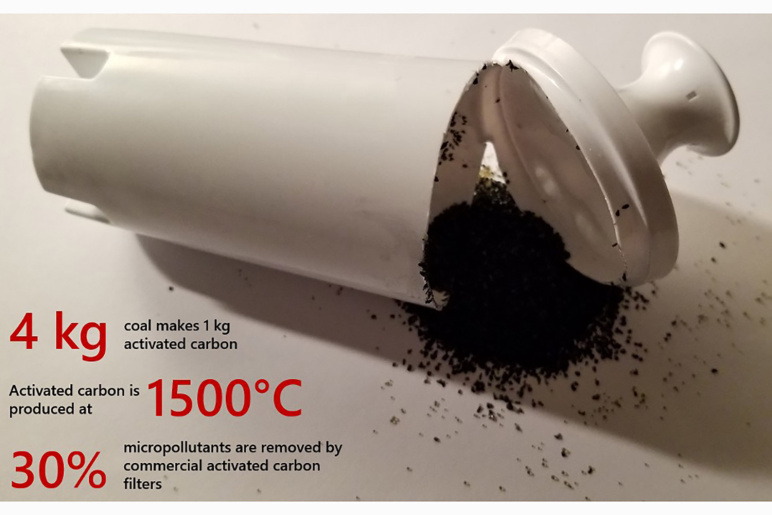
A picture of a representative activated carbon filter the team is seeking to replace in household and industrial water treatment. The filter is opened to show the activated carbon inside. Some salient information based on the team's research and literature are shown on the bottom left.
Graduate student Devashish Gokhale working on the hydrogel technology in the Doyle group lab at MIT. (Image credit: Sebastian Gonzalez Quintero)
Hydrogel microparticles saturated with iron after being used to clean highly contaminated water. (Image credit: Sebastian Gonzalez Quintero)
A bench-scale test filter used by the team in early experiments. (Image credit: Sebastian Gonzalez Quintero)
Overview of water treatment technology. Monomer solution is polymerized to make microparticles using scalable fluid processing. Microparticles can have different functionalities and each functionality can be tuned (change surfactants, chelating agents).
Sites at which PFAS, a specific kind of micropollutant were known to be persistently present, as of 2022 (figure taken from https://www.ewg.org).
A picture of a representative activated carbon filter the team is seeking to replace in household and industrial water treatment. The filter is opened to show the activated carbon inside. Some salient information based on the team's research and literature are shown on the bottom left.
Principal Investigator

Patrick Doyle
- Robert T. Haslam (1911) Professor of Chemical Engineering
- Department of Chemical Engineering
Pat Doyle is a chemical engineering professor at MIT with broad research interests ranging from fundamental studies of single DNA molecules to microfluidic devices, to water purification, to the design of new technologies for spatial detection of miRNA. He is also the co-founder of the startup companies Drosera Biotechnologies, Firefly Bioworks (acquired by Abcam in 2015), and Motif Micro (acquired by YPB Systems in 2018). He works closely with many companies as either a consultant, SAB advisor or through sponsored research in his lab.
Challenge:
Can we build cost-effective industry-scale processes using sustainable hydrogel microparticles to rapidly remove micropollutants from water?
Research Strategy
- Test hydrogel microparticles for the treatment of real wastewater samples contaminated with organic and inorganic micropollutants
- Rapidly optimize microparticle composition for representative wastewater samples using machine learning
- Build prototype units to treat water and regenerate spent absorbent
- Perform technoeconomic analyses and market research to formulate a preliminary business plan
Project description

Micropollutants are contaminants that occur in low concentrations in the environment, yet continuous exposure and bioaccumulation of micropollutants make them a cause for concern. Each specific micropollutant contributes little to water pollution in terms of mass, but low concentrations and chemical diversity make it difficult to remove micropollutants from water inexpensively.
Professor Doyle and his team are developing a technology that uses sustainable hydrogel microparticles optimized with machine learning to remove micropollutants from water. The microparticles are long-lasting, reusable, and show faster uptake than commercial materials, thereby benefiting society by enabling access to clean water (UN Sustainable Development Goal 6). Economically, the technology is a new offering that will find applications in numerous large markets where micropollutant elimination is vital, in the form of municipal and industrial water treatment equipment ($12.8 billion in 2021), and household water purification systems ($5.85 billion in 2021).
The J-WAFS Solutions grant will help the researchers build and test prototype pilot-scale water treatment systems to clean simulated and real wastewater using sustainable hydrogels. The team plans to identify the best use cases and customers, utilizing commercialization support activities associated with the Solutions grant to spin out a startup company.
Outcomes
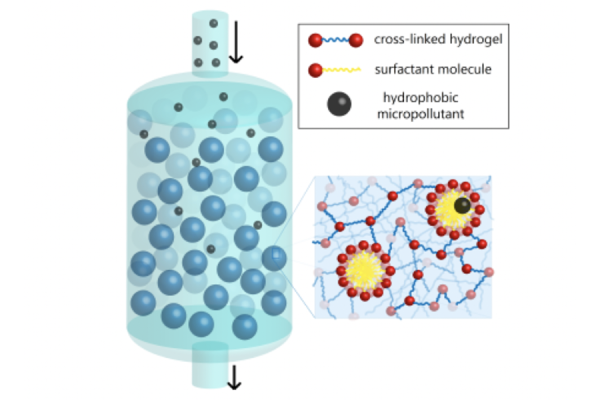
- Developed a platform solution that employs novel hydrogel microparticles, consisting of chemically bound micelles, chelating agents, and zwitterionic monomers, to rapidly absorb both organic and inorganic micropollutants from water in a single step. The hydrogels are tunable, reusable over long cycles, and process and industry agnostic, allowing them to be easily incorporated into existing processes
- Developed two scaled up approaches to manufacture the hydrogel beads
- Tested and refined bench-scale prototypes of the hydrogel platform both in the lab and through a number of commercialization programs at MIT and in the greater Boston area
- Proved that the system: can clean highly contaminated water to below regulatory limits on contaminants in drinking water; has a significantly lower carbon footprint than existing solutions; can treat complex mixtures of chemically diverse micropollutants at least 10 times more rapidly than a commercial AC/ion exchange resin mixture, and up to 100 times faster than other multifunctional adsorbents reported in literature
- Participated in customer discovery programs and conducting over 120 interviews with stakeholders across biopharmaceuticals, food tech, synthetic biology, and enzyme production. Found that biomanufacturing, in particular, is an innovation-friendly market with urgent purification challenges
- Tested samples from different potential customers in the water treatment and biomanufacturing spaces
- Created Drosera Biotechnologies, Inc. to commercialize the technology
Publications
Navigating micropollutant contamination: A review of industrial wastewater technologies and policies in the U.S.
Arjav Shah and Devashish Gokhale, MIT Science Policy Review, 2024
A Zwitterionic Hydrogel-Based Heterogeneous Fenton Catalyst for Water Treatment
Devashish Gokhale, Ian Chen, Wan-Ni Wu, Arthur Monne Gagnaire, and Patrick S. Doyle, Small Early View, 2024
Yeast-laden hydrogel capsules for scalable trace lead removal from water
Devashish Gokhale, Patritsia M. Stathatou, Christos E. Athanasioud, and Patrick S. Doyle, RSC Sustainability, 2024
Multifunctional zwitterionic hydrogels for the rapid elimination of organic and inorganic micropollutants from water
Devashish Gokhale, Andre F. Hamelberg, and Patrick S. Doyle, Nature, 2024
News
Spinout Company
Drosera Bio

Drosera Bio is leading the way in commercializing purification technologies, making biomanufacturing more sustainable and affordable.
Additional Details
Impact Areas
- Water
- Climate & Sustainability
Research Themes
- Water Purification & Desalination
- Technology & Commercialization
- Sustainability & Adaptation
Year Funded
- 2022
Grant Type
- Solutions Grant
Status
- Completed